Will Mortgage Interest Rates Go Down in North Austin?
What Buyers and Sellers Can Consider Now
If you’re thinking about buying or selling a home in North Austin, you may be asking the same question we hear often: Should I wait for mortgage rates to go down?
The honest answer is that no one can reliably tell you when rates will fall, how far they might move, or what rate you’ll qualify for. Mortgage rates respond to broader financial conditions, and an individual loan offer also depends on factors such as the loan type, down payment and borrower qualifications. The rate you see in a headline may be different from the rate a lender offers you.
That uncertainty doesn’t mean you have to put every plan on hold. It means the useful question is more personal: What would buying or selling look like for you at today’s numbers, and what would need to change for the move to make sense?
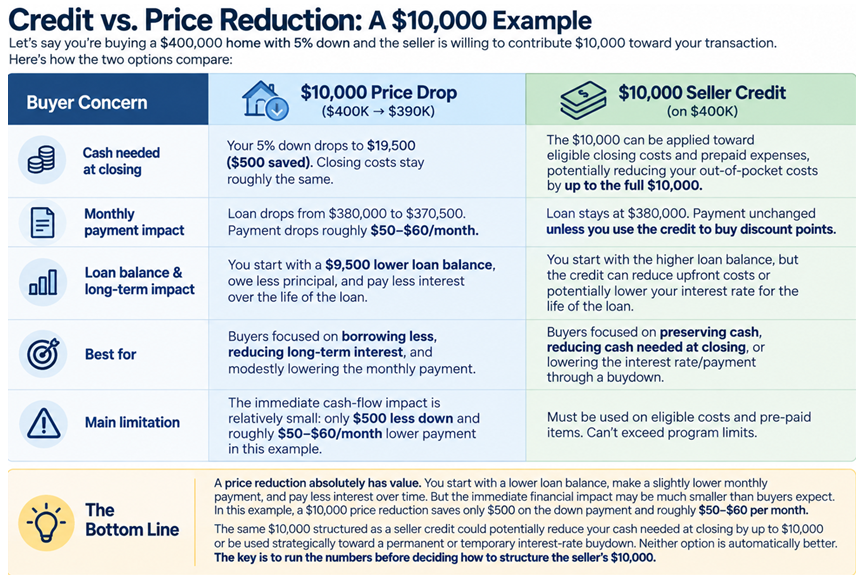
The figures above are illustrations, not a loan quote or a prediction of future rates. Actual payments, closing costs, available credits and loan terms depend on the property, lender, loan program and buyer qualifications.
Should North Austin buyers wait for lower mortgage rates? 📉
Waiting may be the right choice if the estimated payment does not fit comfortably within your budget. But a lower future rate is only one part of the decision. The price of the home, your available cash, property taxes, insurance, HOA dues and the terms you negotiate all affect the total cost of buying.
If you find a home in Round Rock, Cedar Park, Leander, Georgetown or North Austin that fits your needs, ask a lender to show you the full monthly payment and cash needed to close. You can then decide based on numbers available now, without assuming rates will fall or that refinancing will be an option later. The Consumer Financial Protection Bureau recommends comparing Loan Estimates, including fees, points and closing costs, rather than looking at the interest rate alone.
A price reduction or a seller credit: What’s the difference? 💲
Imagine a buyer considering a $400,000 home with a 5% down payment, and the seller is open to negotiating $10,000. There are two possible ways to structure that conversation:
A $10,000 price reduction would bring the purchase price to $390,000. At 5% down, the down payment would be $19,500 instead of $20,000, assuming the same financing structure. The buyer would also begin with a smaller loan balance. That may lower the monthly principal and interest payment, though the exact difference depends on the loan terms.
A $10,000 seller credit would leave the purchase price at $400,000. If permitted by the lender and loan program, the credit could help pay eligible closing costs, prepaid expenses or the cost of a mortgage rate buydown. It generally cannot replace the buyer’s required down payment. The amount a buyer can actually use depends on the loan program, the transaction and the eligible costs.
Neither option is automatically better. A lower price can reduce the amount borrowed. A usable seller credit may help a buyer keep more cash available at closing or, if applied toward discount points, obtain a lower interest rate. A lender should calculate both scenarios before the buyer chooses one. Discount points have an upfront cost, and the amount by which they lower a rate is not fixed.
What does this mean if you’re selling a home in North Austin? 🏠
Buyers often care about more than the list price. Some are focused on their monthly payment. Others are focused on how much cash they need to close. That’s why the way you respond to an offer may matter as much as the dollar amount you negotiate.
A price adjustment, seller credit or other negotiated term might help a particular buyer move forward, but the best approach depends on your home, your goals and the offers you receive. Before deciding, we can look at comparable sales and competing listings, then estimate what different terms could mean for your proceeds. Your agent and the buyer’s lender can help confirm whether a proposed credit works with the buyer’s financing.
What should you do if you’re considering a move? 🚚
Start with a conversation and real numbers. If you’re buying, find out what homes in your target area cost and request a lender estimate for a payment and closing budget that feel comfortable to you. If you’re selling, find out what your home may be worth in the current market and what you could take away after estimated selling expenses.
You don’t need to predict the next rate change to begin planning. You need to understand your options well enough to decide whether this move, at these numbers, is right for you.
Let’s Look at Your Options Together
If you’re considering buying or selling in Round Rock, North Austin or the surrounding communities, reach out to The Schauer Team today. Tell us what you’re hoping to do and when. We’ll help you look at the local real estate picture, talk through possible negotiation strategies, and connect you with a lender for loan-specific estimates.